
For years, the value-add multifamily playbook was relatively straightforward.
Buy an underperforming property.
Renovate the units.
Upgrade the common areas.
Increase rents.
Stabilize the asset.
Sell or refinance.
The strategy worked exceptionally well in an environment characterized by strong rent growth, inexpensive capital and abundant opportunities to reposition older properties.
But the multifamily investment environment of 2026 is different.
Capital is more selective.
Operating costs are higher.
Insurance has become a much larger expense.
Rent growth has normalized.
And investors are paying closer attention to actual cash flow.
That is creating a new version of value-add investing.
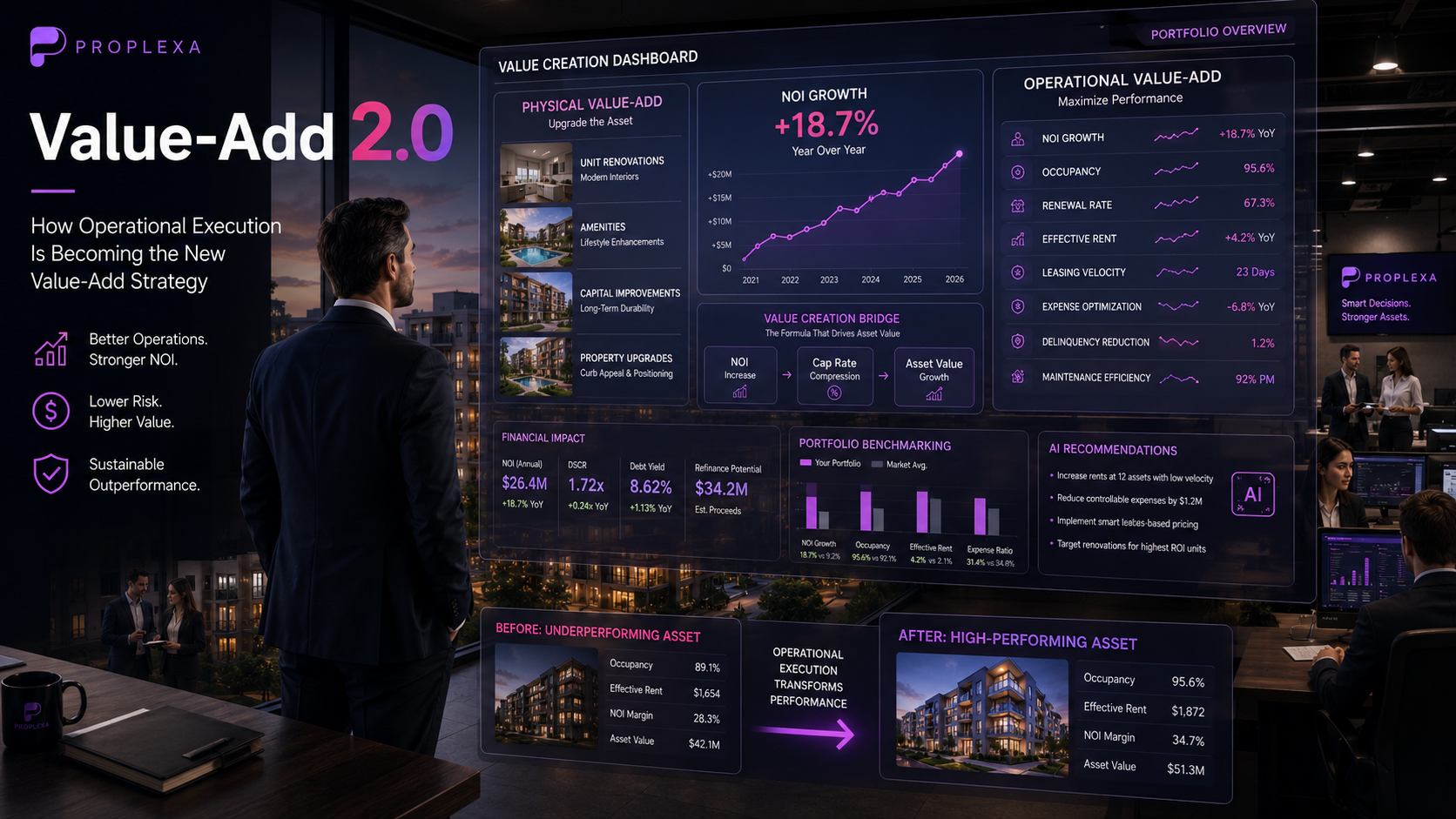
Value-Add 2.0 is increasingly about operational execution.
The Old Value-Add Model
Traditional value-add strategies typically focus on physical improvements:
- Unit renovations
- Flooring
- Countertops
- Appliances
- Lighting
- Clubhouses
- Fitness centers
- Landscaping
- Amenities
The thesis is simple:
Invest capital.
Improve the property.
Increase achievable rent.
Increase NOI.
Increase value.
There is nothing wrong with this strategy.
But there is another opportunity that investors sometimes overlook:
Improving the way the property is operated.
The Operational Value-Add
Imagine two identical multifamily communities.
Both have:
500 units.
Both generate approximately $12 million in annual revenue.
But one operates with:
- Lower vacancy
- Faster leasing
- Higher renewal rates
- Lower delinquency
- Better maintenance efficiency
- Stronger vendor management
- Better expense controls
- More accurate revenue management
The buildings may look identical.
But the financial performance isn't.
That difference is operational alpha.
Why This Matters More in 2026
The operating environment has become more expensive.
Harvard University's Joint Center for Housing Studies reported in its America's Rental Housing 2026 report that multifamily insurance costs doubled between 2019 and 2024. It also found that payroll, administrative costs and utilities increased by more than 20% during that period, while maintenance, taxes and marketing costs increased by more than 10%.
At the same time, apartment NOI growth had slowed to 4.3% annually in Q4 2025, below the 5.2% average pace recorded from 2015–2019.
This creates a challenging equation.
When operating expenses rise faster than revenue, owners cannot simply rely on rent increases to maintain margins.
They have to become better operators.
Value Creation Is Ultimately About NOI
The fundamental valuation equation remains unchanged:
Property Value = NOI ÷ Cap Rate
That means investors can create value through two primary mechanisms:
Increase NOI
or
Improve the market's valuation of that NOI.
For operating assets, the first mechanism is often the most directly controllable.
Suppose an apartment community generates:
$2,000,000 NOI
At a:
5.0% cap rate
Its implied value is:
$40 million.
Now suppose operational improvements increase NOI by:
$200,000
Without changing the cap rate, the implied value becomes:
$44 million.
That's:
$4 million of additional value.
The investor didn't necessarily add $4 million of physical improvements.
They improved the economics of the asset.
The Most Powerful Value-Add May Not Be Physical
Consider the following operational improvements:
Occupancy
95% → 97%
Renewal rate
55% → 65%
Delinquency
2.5% → 1.5%
Average days vacant
35 → 24
Maintenance response time
36 hours → 18 hours
Operating expenses
$10,000/unit → $9,500/unit
None of these require completely renovating the property.
But together, they can materially change NOI.
This is why sophisticated asset managers increasingly evaluate operational performance alongside physical improvements.
The Refinancing Problem Makes NOI Even More Important
There is another reason this matters in 2026.
A significant volume of commercial real estate debt is reaching maturity.
According to the Mortgage Bankers Association, approximately $875 billion, or 17% of outstanding commercial mortgage balances, was scheduled to mature during 2026.
For owners approaching refinancing, property performance matters.
Lenders evaluate factors such as:
- NOI
- Debt service coverage ratio
- Debt yield
- Occupancy
- Property value
- Market fundamentals
- Sponsor strength
A stronger NOI profile can improve the financial position of the asset when refinancing becomes necessary.
Operational Performance Can Improve Debt Capacity
Consider a simplified example.
An asset produces:
$2 million NOI
If a lender requires a:
1.25x DSCR
and the loan's annual debt service is:
$1.6 million
the property doesn't satisfy that requirement.
But suppose operational improvements increase NOI to:
$2.2 million
The asset now has significantly more cash flow available to support debt service.
Operational improvements can therefore affect more than valuation.
They can influence financing capacity.
Revenue Optimization Is Part of Value-Add
Revenue management is one of the largest operational opportunities.
Property managers can optimize:
- Asking rents
- Renewal increases
- Lease expiration timing
- Concessions
- Unit-level pricing
- Lease-up velocity
- Premium unit pricing
- Ancillary revenue
The objective isn't necessarily to maximize asking rent.
It is to maximize:
Sustainable effective revenue.
That distinction is critical.
Occupancy and Rent Must Be Optimized Together
An aggressive rent increase can look successful on paper.
But if it causes:
- Higher vacancy
- Longer days to lease
- More concessions
- Lower conversion
the strategy may actually reduce NOI.
Sophisticated revenue management therefore optimizes the relationship between:
Price × Occupancy × Retention × Leasing Velocity
rather than focusing on price alone.
Expense Optimization Is the Other Side of the Equation
Revenue is only half the story.
The other half is expense management.
Owners should analyze:
- Insurance
- Payroll
- Utilities
- Maintenance
- Vendor contracts
- Turnover costs
- Marketing
- Administrative expenses
- Property taxes
Harvard JCHS's 2026 report demonstrates just how significant these cost pressures have become.
This is why property managers increasingly need to behave like financial operators—not simply administrators.
Vendor Management Can Create Hidden Value
A 500-unit portfolio can generate thousands of vendor transactions.
Small inefficiencies can compound.
Examples include:
- Paying inconsistent vendor rates
- Poor contract negotiation
- Excessive emergency premiums
- Weak quality control
- Slow completion times
- Duplicate services
A professional operator can create value by establishing:
- Competitive bidding
- Portfolio-level pricing
- Vendor scorecards
- Service-level agreements
- Insurance verification
- Performance monitoring
The result is not simply a lower expense.
It is a more predictable expense structure.
Preventive Maintenance Is Asset Management
Maintenance is often treated as an operating expense.
But it is also an asset-preservation strategy.
Deferred maintenance can eventually lead to:
- Higher repair costs
- Resident dissatisfaction
- Increased vacancy
- Capital expenditure
- Regulatory issues
- Lower asset appeal
A preventive maintenance program attempts to shift the property from:
Reactive maintenance
to:
Predictable maintenance.
That distinction matters enormously for long-term asset value.
Resident Retention Creates Operational Alpha
Every move-out creates friction.
The property may need to:
- Market the unit.
- Schedule tours.
- Process applications.
- Prepare the apartment.
- Repair damage.
- Clean the unit.
- Absorb vacancy.
- Onboard a new resident.
A renewal can eliminate much of this process.
That is why retention isn't simply a resident-experience metric.
It is an economic variable.
Technology Is Accelerating Operational Value Creation
Property management technology is also changing the value-add equation.
Modern platforms can help operators automate:
- Lead responses
- Leasing communication
- Resident notifications
- Work-order routing
- Inspections
- Reporting
- Revenue analysis
AI adds another layer.
Instead of simply reporting:
"Occupancy fell 1.5%."
A modern analytics system can potentially identify:
- Which unit types are underperforming.
- Which lead sources are converting poorly.
- Which leasing agents have lower conversion.
- Which renewal cohorts are at risk.
- Which properties are diverging from market benchmarks.
That moves property management from reporting toward decision intelligence.
The New Value-Add Scorecard
Investors should increasingly evaluate value-add opportunities using two dimensions.
Physical Value Creation
- Renovations
- Amenities
- Unit upgrades
- Exterior improvements
- Energy improvements
Operational Value Creation
- Occupancy
- Renewal rate
- Effective rent
- Concessions
- Leasing velocity
- Delinquency
- Maintenance
- Vendor efficiency
- Operating expenses
- Resident satisfaction
The strongest investment strategies often combine both.
The Property Manager Can Become the Value-Creation Partner
This changes how owners should evaluate property management companies.
Instead of asking:
"How much do you charge?"
ask:
"How will you create value?"
A sophisticated management proposal should explain:
Revenue Strategy
How will you improve effective revenue?
Leasing Strategy
How will you reduce vacancy?
Retention Strategy
How will you improve renewals?
Expense Strategy
How will you control operating costs?
Maintenance Strategy
How will you preserve the asset?
Technology Strategy
How will data improve decisions?
Reporting Strategy
How will owners measure the results?
These questions transform the management relationship.
Not Every Property Needs a Renovation
This may be one of the most important lessons for investors.
A property doesn't always need a $20 million renovation program to create value.
Sometimes the biggest opportunity is operational.
For example:
A property with poor leasing execution.
A property with excessive concessions.
A property with high turnover.
A property with inefficient vendor contracts.
A property with weak financial reporting.
A property with poor maintenance processes.
These assets may have significant untapped value even before a major capital improvement program begins.
The Best Value-Add Strategy Is Property-Specific
There is no universal formula.
A Sun Belt Class A community facing new supply may need a different strategy than an older Class B community in the Midwest.
The correct strategy depends on:
- Market supply
- Competitive positioning
- Asset class
- Resident profile
- Physical condition
- Current occupancy
- Rent positioning
- Operating expenses
- Capital structure
- Hold period
This is why asset-level analysis matters.
How Proplexa Fits Into Value-Add Investing
If operational execution can materially influence asset performance, then selecting the right property manager becomes part of the investment strategy.
Proplexa helps owners compare management companies based on more than price.
Owners can evaluate:
- Experience
- Operational capabilities
- Technology
- Reporting
- Leasing strategy
- Maintenance capabilities
- Communication
- Overall value
The objective isn't to find the cheapest manager.
It is to identify the management partner most capable of executing the property's business plan.
Final Thoughts
The first generation of value-add investing was largely about physical transformation.
The next generation is increasingly about operational transformation.
Renovating an apartment can create value.
But so can:
- Reducing vacancy.
- Increasing renewals.
- Improving leasing velocity.
- Controlling expenses.
- Improving maintenance.
- Optimizing pricing.
- Reducing delinquency.
- Improving resident experience.
And unlike a renovation, many operational improvements can be implemented across an entire portfolio.
In a 2026 market characterized by higher operating costs, selective capital and significant refinancing activity, execution matters.
The next generation of multifamily winners may not simply own better buildings.
They may operate them better.