
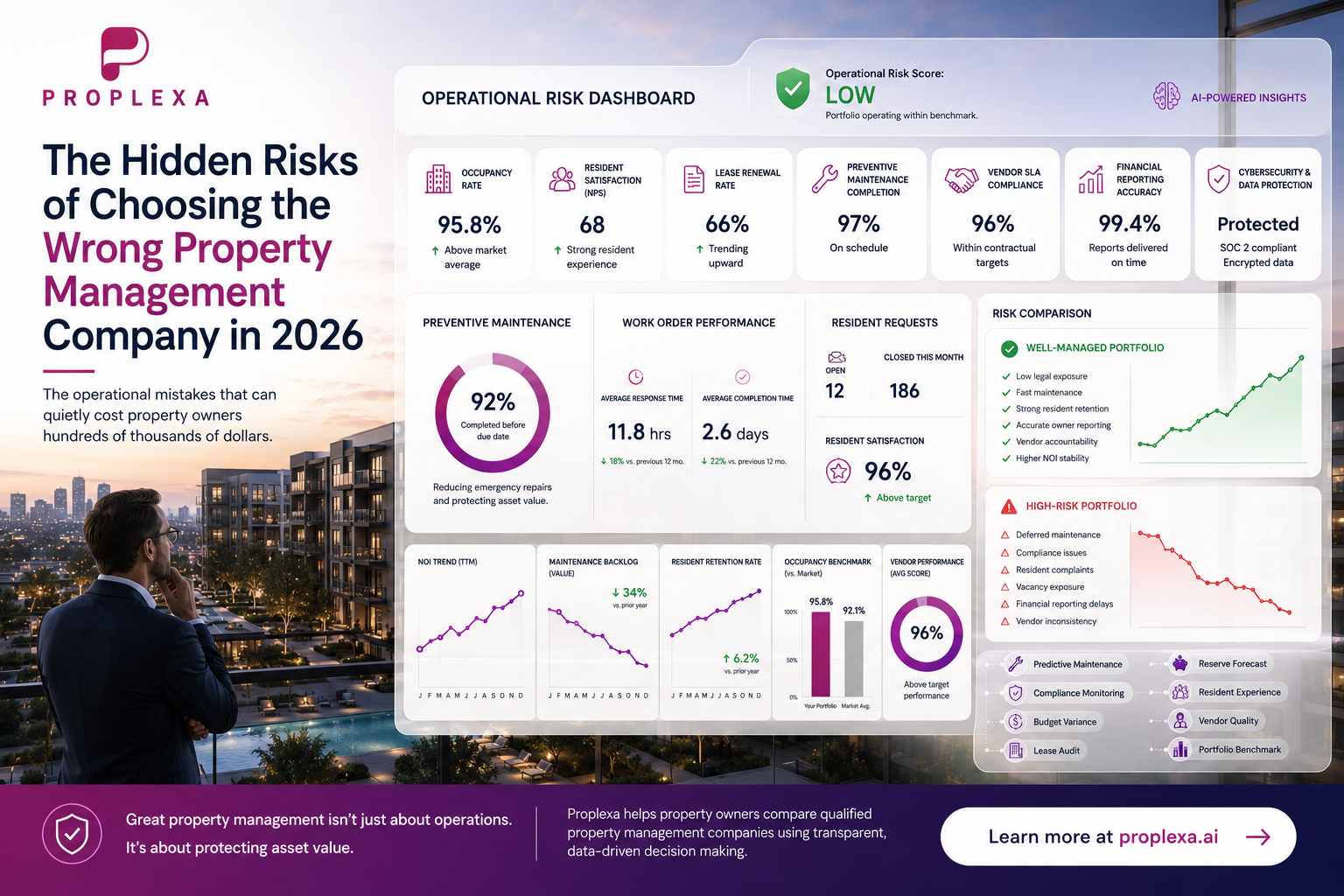
Most property owners spend considerable time analyzing acquisition opportunities.
They compare markets.
Interest rates.
Cap rates.
Financing structures.
But once the acquisition closes, one decision often receives surprisingly little attention:
Who will actually operate the asset?
In today's multifamily market, operational execution increasingly determines investment performance.
A poorly selected property management company doesn't simply create inconvenience.
It creates risk.
And unlike market cycles, operational risks are often preventable.
Property Management Is Risk Management
Many owners still view property management as an administrative service.
Collect rent.
Coordinate maintenance.
Pay vendors.
Prepare monthly reports.
Modern institutional investors see something different.
Property management is the primary operational control system protecting the value of an income-producing asset.
Every decision affects:
- Revenue
- Expenses
- Resident satisfaction
- Regulatory compliance
- Reputation
- Asset valuation
When operations fail, financial performance follows.
The Cost of Small Operational Failures
Major losses rarely begin with catastrophic events.
They usually begin with dozens of small problems.
Examples include:
• Maintenance requests remaining open for weeks.
• Leasing inquiries going unanswered.
• Delayed rent collection.
• Vendor invoices lacking oversight.
• Incomplete owner reporting.
• Poor communication with residents.
Individually, each issue appears manageable.
Collectively, they reduce NOI year after year.
Regulatory Compliance Is Becoming More Complex
The regulatory environment for rental housing continues to evolve.
Property managers must increasingly navigate:
- Fair Housing compliance
- ADA accessibility requirements
- Local rental registration programs
- Building safety inspections
- Data privacy obligations
- Vendor insurance verification
- Security deposit regulations
- Short-term rental restrictions in many municipalities
Failure to comply can expose owners to:
- Fines
- Lawsuits
- Insurance disputes
- Reputational damage
- Unexpected operating costs
As portfolios grow, compliance becomes increasingly dependent on management quality rather than owner oversight.
Maintenance Isn't an Expense—It's Risk Prevention
Deferred maintenance is among the fastest ways to destroy long-term asset value.
Minor issues frequently escalate:
A leaking pipe becomes structural damage.
An HVAC issue becomes multiple resident complaints.
Delayed repairs increase resident turnover.
Emergency repairs cost significantly more than preventive maintenance.
According to industry research, preventive maintenance programs consistently reduce emergency repair frequency while extending the useful life of major building systems.
Leading operators increasingly rely on preventive maintenance schedules supported by digital work order systems instead of reactive maintenance alone.
Poor Leasing Execution Can Quietly Destroy Revenue
Every vacant unit represents lost income.
Yet vacancy isn't determined solely by market conditions.
Operational execution matters.
Leading management companies monitor:
- Lead response times
- Tour-to-lease conversion rates
- Application processing speed
- Lease approval timelines
- Follow-up automation
Research across multifamily leasing consistently shows that prospects are significantly more likely to lease when contacted quickly after submitting an inquiry.
The difference between responding in minutes versus hours often determines whether a prospect signs a lease—or chooses another community.
Resident Experience Is Now a Risk Indicator
Resident satisfaction has become increasingly measurable.
Poor experiences generate:
- Negative online reviews
- Lower renewal rates
- Increased turnover
- More concessions
- Reduced occupancy
- Higher marketing costs
Satisfied residents create:
Higher retention.
Lower acquisition costs.
More referrals.
More stable cash flow.
Resident experience is no longer just a customer service metric.
It's a financial performance indicator.
Cybersecurity Is Now Part of Property Management
Property management companies increasingly handle:
- Social Security Numbers
- Bank account information
- Online rent payments
- Lease documentation
- Maintenance records
- Owner financial reports
Cybersecurity failures now represent operational risks.
Professional management firms increasingly invest in:
- Multi-factor authentication
- Encrypted payment systems
- Secure resident portals
- Access controls
- Cloud-based backups
- Cybersecurity training
Owners should understand how sensitive data is protected before signing a management agreement.
Technology Alone Doesn't Reduce Risk
Technology has become essential.
But software doesn't replace operational discipline.
The best property management companies combine:
AI-assisted leasing
Automated maintenance workflows
Business intelligence dashboards
Resident communication platforms
Digital inspections
Vendor management systems
Standard operating procedures
Technology enables consistency.
Execution creates results.
Why Operational Transparency Matters
One of the biggest challenges facing property owners is the inability to compare management companies objectively.
Most proposals describe services.
Few provide measurable operational benchmarks.
Without standardized comparisons, selecting a manager becomes largely subjective.
That's exactly the problem Proplexa was designed to solve.
Instead of relying solely on marketing presentations, owners can evaluate multiple proposals side by side, comparing pricing, capabilities, technology, experience, reporting practices, and operational performance.
Better comparisons lead to better decisions.
Better decisions reduce operational risk.
Final Thoughts
Markets fluctuate.
Interest rates change.
Cap rates compress and expand.
But operational excellence remains one of the few variables property owners can actively control.
Choosing the right property management company isn't simply about finding someone to operate a building.
It's about selecting the team responsible for protecting millions of dollars in assets.
Because in 2026, the greatest threat to portfolio performance often isn't the market.
It's operational execution.
And the best investors understand that reducing operational risk is one of the highest-return investments they can make.