
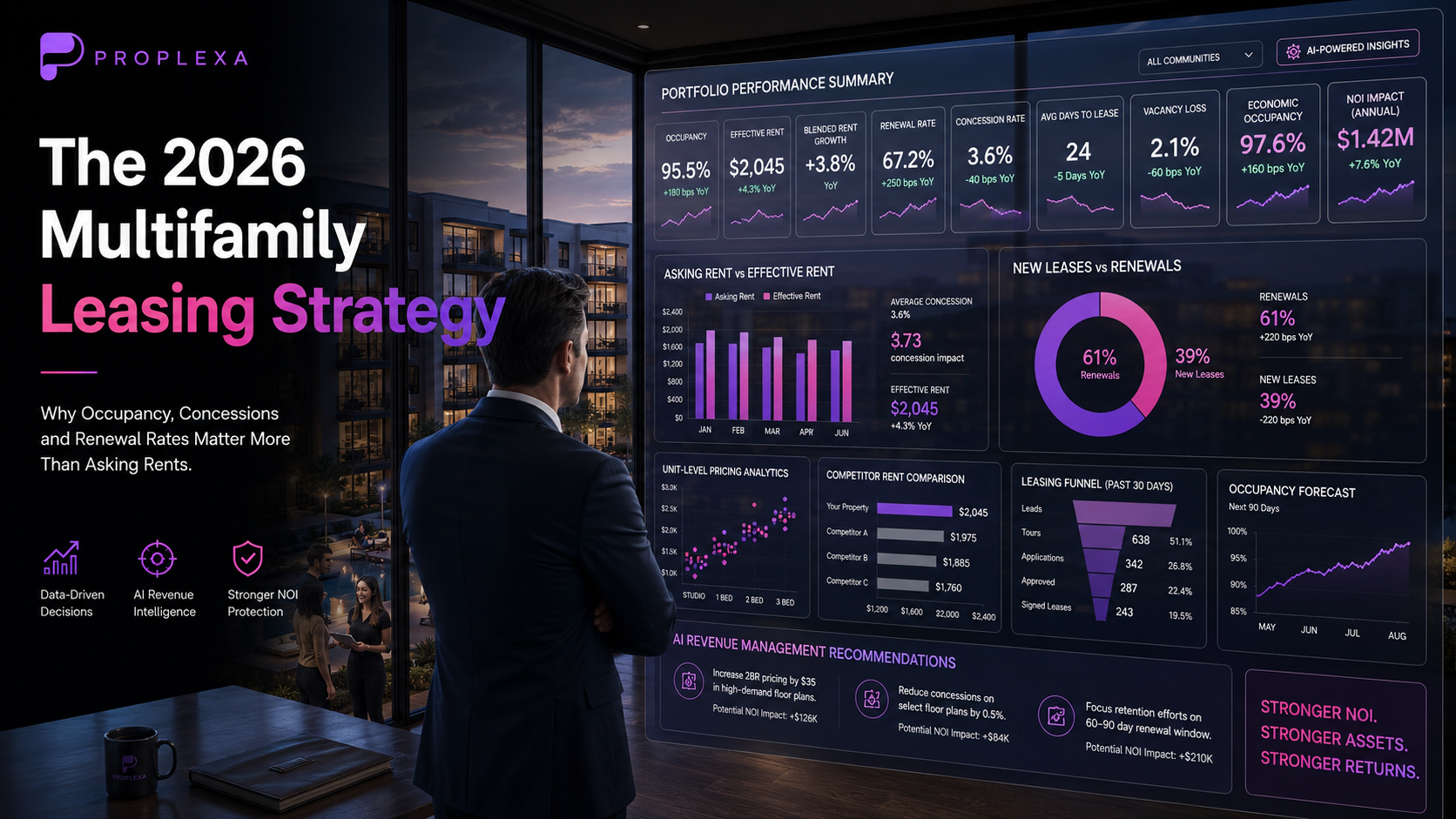
For years, one of the simplest ways to evaluate a multifamily market was to look at rent growth.
If rents were increasing, the market was strong.
If rents were declining, the market was weak.
In 2026, that approach is becoming increasingly incomplete.
The U.S. multifamily market is entering a more complicated phase.
Supply is beginning to moderate, occupancy has improved, but rent growth remains subdued and concessions remain widespread.
According to RealPage Market Analytics, U.S. apartment occupancy reached 95.5% in Q2 2026, while effective asking rents remained 0.2% below the prior year. At the same time, approximately 24.6% of apartments were offering concessions, with an average concession of 7.6%.
The result?
Property owners need to rethink what "successful leasing" actually means.
The Problem With Looking Only at Asking Rents
Suppose an apartment community advertises:
$2,000/month
That number looks attractive.
But what happens if the property offers:
- One month free
- Reduced deposits
- Waived application fees
- Move-in credits
- Other incentives
The advertised rent isn't necessarily the economic rent.
This distinction is increasingly important in 2026.
RealPage reported that in June, 16.5% of stabilized U.S. apartments offered concessions, while the average concession reached 11.1%—equivalent to nearly six weeks of free rent on a 12-month lease.
For owners, the question is therefore not:
"What rent are we advertising?"
It is:
"What revenue are we actually collecting after incentives?"
The Concession Trap
Concessions are not inherently bad.
In a highly competitive submarket, offering an incentive can be a rational revenue-management decision.
The problem occurs when concessions become permanent.
Consider a hypothetical apartment:
Market rent: $2,000/month
A property offers one month free on a 12-month lease.
Annual gross scheduled rent:
$24,000
Effective first-year revenue after one free month:
$22,000
That's an effective monthly rent of approximately:
$1,833
The property is still advertising a $2,000 rent.
But the economics are very different.
This is why sophisticated owners track effective rent, not simply asking rent.
Concessions Are Still Historically Elevated
The national picture reinforces the issue.
RealPage's June 2026 data showed concession usage near its highest levels since the mid-2010s, while the average discount reached its deepest level in more than 25 years.
And the pressure is not evenly distributed.
In June:
- Class C: 20.7% of units offering concessions
- Class B: 15.1%
- Class A: 13.7%
That tells an important story.
Revenue-management strategies need to be asset-specific.
There is no universal leasing strategy that works equally well for Class A, B and C properties.
Occupancy Has Become a Strategic Priority
In an environment with significant new supply, maintaining occupancy can be more valuable than maximizing asking rent.
CBRE expects multifamily operators to prioritize occupancy during 2026, particularly in markets where large volumes of recently delivered units are competing for residents.
That creates a strategic tradeoff:
Strategy A
Higher asking rent.
Lower occupancy.
More concessions.
Longer vacancy periods.
Strategy B
Competitive effective rent.
Higher occupancy.
Faster leasing.
Lower vacancy loss.
The better strategy depends on the property's economics.
The important point is that rent growth cannot be evaluated independently from occupancy.
The Renewal Advantage
One of the most important—and frequently overlooked—developments in multifamily leasing is the increasing importance of renewals.
According to CBRE, renewal leases represented approximately 57% of all multifamily leasing activity in 2026, compared with 51% in 2015 and 48% in 2005.
Why does this matter?
Because a renewal avoids many of the costs associated with a move-out.
When a resident leaves, the property can incur:
- Lost rent
- Vacancy loss
- Turnover costs
- Cleaning
- Repairs
- Marketing
- Leasing commissions or labor
- Administrative costs
A renewal can eliminate much of that friction.
Renewal Rent Growth vs. New-Lease Rent Growth
Here's where the analysis becomes particularly interesting.
CBRE notes that renewal rent growth is currently outperforming asking rent growth for new leases.
This means traditional rent-growth headlines can actually understate the revenue performance of an existing property.
CBRE calls the more comprehensive metric:
Blended Rent Growth
Blended rent growth combines:
- Renewal rent growth
- Effective asking-rent growth on new leases
The resulting number provides a more representative picture of the actual revenue dynamics within an operating property.
Why Blended Rent Growth Matters to Investors
Imagine a market where:
New-lease asking rent growth: -1%
That sounds negative.
But suppose:
Renewal rent growth: +4%
And 57% of leasing activity consists of renewals.
The property-level revenue picture could be considerably stronger than the headline asking-rent number suggests.
This is why sophisticated investors should distinguish between:
Market asking rent growth
and
Actual property-level blended rent growth.
They are not the same metric.
The Leasing Funnel Matters Too
Rent is only one part of leasing performance.
A sophisticated property manager should monitor the entire leasing funnel.
For example:
Lead Generation
How many qualified prospects are entering the funnel?
Lead Response Time
How quickly does the leasing team respond?
Tour Conversion
How many prospects schedule and complete tours?
Application Conversion
How many tours become applications?
Approval Rate
How many applications become approved residents?
Lease Conversion
How many approved applicants actually execute leases?
Days to Availability
How quickly does a vacant unit become market-ready?
Days to Lease
How quickly does the property convert the unit into a signed lease?
Every stage represents potential revenue leakage.
A Vacancy Day Has a Real Economic Cost
Consider a property with:
200 units
Average monthly rent:
$2,000
A single vacant unit represents approximately:
$66 of potential rent per day.
If operational delays cause a unit to remain vacant for an additional 20 days, the property has potentially lost approximately:
$1,333 of rental revenue.
Multiply that across dozens of annual turnovers and the impact becomes significant.
This is why leasing velocity should be treated as a financial KPI—not simply a marketing metric.
The New Leasing KPI Stack
In 2026, owners should evaluate leasing performance using a broader dashboard.
Revenue KPIs
- Effective rent
- Blended rent growth
- Revenue per available unit
- Economic occupancy
Leasing KPIs
- Days to lease
- Lead-to-tour conversion
- Tour-to-application conversion
- Application-to-lease conversion
- Vacancy days
Resident KPIs
- Renewal rate
- Renewal rent growth
- Resident satisfaction
- Move-out reasons
Marketing KPIs
- Cost per lead
- Cost per lease
- Lead source
- Digital conversion rate
This creates a much more complete picture of revenue performance.
Technology Is Changing Revenue Management
Modern property management technology increasingly allows operators to analyze leasing data in real time.
Revenue-management platforms can evaluate:
- Competitor rents
- Unit-level demand
- Lease expiration dates
- Historical leasing velocity
- Seasonal demand
- Concession effectiveness
- Unit attributes
- Market conditions
AI can further enhance this analysis by identifying patterns across large datasets.
But technology doesn't replace strategy.
The best results occur when technology helps property managers make faster, better-informed decisions.
The Risk of Treating Every Unit the Same
One of the biggest mistakes in multifamily revenue management is applying the same pricing strategy to every unit.
Two apartments in the same building can have different economics because of:
- Floor
- View
- Renovation level
- Floor plan
- Exposure
- Parking
- Amenities
- Lease expiration
- Competitive supply
A sophisticated operator should therefore think at the unit level, not simply the property level.
The Market Is Rebalancing—But Owners Still Have to Execute
There is a positive development emerging.
Supply is beginning to normalize.
RealPage reported that annual U.S. apartment supply had fallen below the decade average by Q2 2026, with approximately 340,200 units delivered during the preceding year.
Yardi Matrix, meanwhile, reported that nearly 1.3 million units remained in lease-up nationally midway through 2026, meaning many markets were still working through substantial supply pressure.
The market is therefore moving toward better balance—but the transition is uneven.
Some markets will regain pricing power sooner than others.
Some properties will outperform.
Others will continue competing through concessions.
The quality of execution matters.
The Property Manager Becomes a Revenue Partner
This is perhaps the most important implication for owners.
Property management should no longer be evaluated exclusively as an administrative function.
A high-performing management company should contribute to:
Revenue optimization.
Occupancy protection.
Renewal strategy.
Leasing velocity.
Concession management.
Resident retention.
NOI growth.
The property manager is increasingly part of the asset's revenue strategy.
How Proplexa Helps Owners Compare Management Capabilities
This is where choosing the right management company becomes particularly important.
Two companies can charge similar fees while producing very different leasing outcomes.
One may have:
- Better revenue-management systems
- Faster lead response
- Stronger renewal processes
- Better market intelligence
- More sophisticated reporting
- Stronger leasing teams
The difference may not appear on the management contract.
It appears in the property's operating results.
Proplexa helps property owners compare property management companies and evaluate proposals based on capabilities, experience, technology, operational strategy and overall value—not simply the headline management fee.
Final Thoughts
The biggest leasing mistake investors can make in 2026 is looking at one number.
Asking rent.
It tells only part of the story.
The more complete picture includes:
Occupancy.
Effective rent.
Concessions.
Renewals.
Blended rent growth.
Leasing velocity.
Vacancy loss.
Economic occupancy.
As the multifamily market moves through its supply rebalancing cycle, the properties that outperform will not necessarily be those charging the highest advertised rents.
They will be the properties managed intelligently.
Because in 2026, leasing isn't simply about getting higher rent.
It's about maximizing sustainable revenue.