
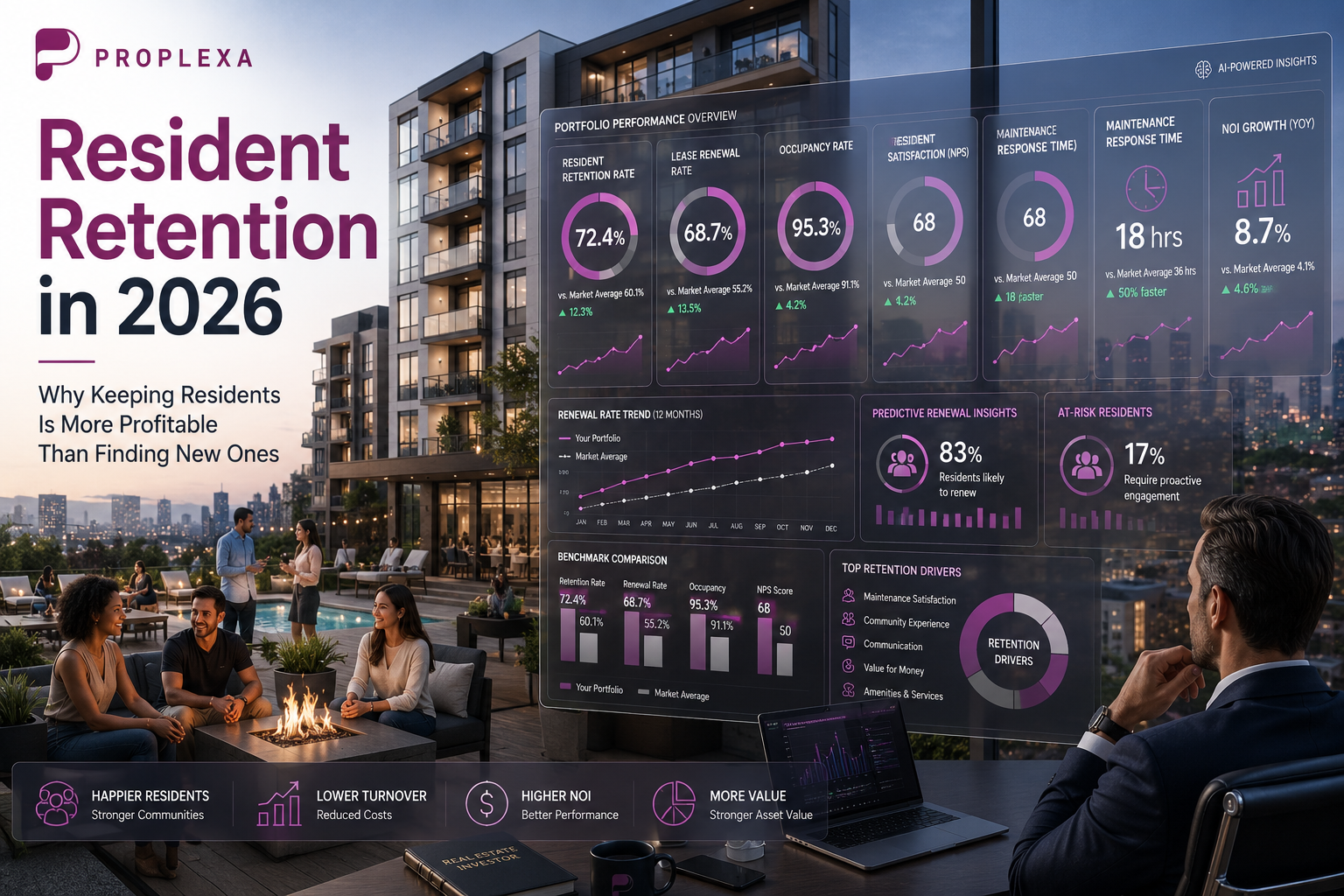
Real estate investors spend enormous amounts of time discussing acquisitions, financing, cap rates, and rent growth.
Yet one of the most important drivers of portfolio performance receives surprisingly little attention:
Resident retention.
Keeping great residents isn't simply about reducing vacancies.
It directly influences operating expenses, leasing costs, cash flow stability, online reputation, and ultimately, property value.
In today's rental market, retention has become a strategic financial metric—not just an operational one.
Why Resident Retention Matters More Than Ever
The U.S. rental market remains fundamentally healthy in 2026, but competition has intensified.
Across many metropolitan areas:
- New apartment deliveries have increased supply.
- Residents have more choices.
- Digital leasing has made switching properties easier.
- Online reviews influence leasing decisions more than ever.
In this environment, every lease renewal represents revenue that doesn't have to be replaced.
Owners who consistently retain residents reduce operational friction while improving financial performance.
The Real Cost of Resident Turnover
When a resident moves out, the cost extends far beyond one month of lost rent.
Typical turnover expenses include:
- Lost rental income during vacancy
- Professional cleaning
- Painting and repairs
- Flooring replacement (when necessary)
- Marketing and advertising
- Leasing commissions
- Staff time
- Utility expenses during vacancy
- Administrative processing
According to the National Apartment Association (NAA), turnover costs can easily reach several thousand dollars per apartment, depending on the market, unit condition, and renovation scope.
For large portfolios, reducing turnover by only a few percentage points can translate into hundreds of thousands of dollars in annual savings.
Renewal Rates Have Become a Competitive Advantage
Leading property management companies increasingly measure success through renewal performance.
Why?
Because higher renewal rates typically produce:
- Lower vacancy
- More stable cash flow
- Lower marketing costs
- Better maintenance planning
- Improved forecasting
- Higher resident satisfaction
Strong renewal performance is often a sign of operational excellence rather than simply resident loyalty.
What Drives Residents to Renew?
Industry research consistently identifies several key drivers.
1. Fast Maintenance Response
Residents increasingly expect maintenance requests to be acknowledged quickly and resolved efficiently.
Speed and communication often matter as much as the repair itself.
2. Consistent Communication
Modern residents expect digital communication.
Mobile portals.
Online payments.
Maintenance updates.
Renewal reminders.
Transparent communication builds trust.
3. Predictable Property Operations
Well-maintained common areas.
Clean amenities.
Reliable vendors.
Consistent landscaping.
Professional management creates confidence.
4. Fair Renewal Pricing
Most residents understand that rents increase.
However, transparent communication about pricing and market conditions significantly improves renewal acceptance.
5. Resident Experience
Increasingly, resident experience functions as a business strategy.
Community events.
Package management.
Smart home technology.
Convenient digital services.
Responsive staff.
These experiences influence renewal decisions far more than many owners realize.
Technology Is Transforming Retention
Artificial intelligence and automation are changing resident engagement.
Many leading property managers now leverage:
- AI-assisted communication
- Automated renewal campaigns
- Resident satisfaction surveys
- Predictive renewal scoring
- Maintenance analytics
- CRM-driven engagement
Rather than reacting to move-outs, managers can proactively identify residents who may be at risk of leaving.
This enables earlier intervention and more personalized communication.
The Financial Impact on NOI
Retention influences nearly every major component of Net Operating Income.
Higher renewals reduce:
- Vacancy loss
- Marketing expenses
- Leasing costs
- Unit preparation expenses
- Administrative labor
At the same time, consistent occupancy stabilizes revenue and improves budgeting accuracy.
Small improvements in retention can compound into meaningful NOI growth across an entire portfolio.
Questions Owners Should Ask Property Managers
When evaluating a management company, consider asking:
- What is your average annual renewal rate?
- How do you measure resident satisfaction?
- What resident engagement technology do you provide?
- How quickly are maintenance requests resolved?
- How do you identify residents at risk of non-renewal?
- What is your average vacancy between leases?
- How do you benchmark retention across your portfolio?
These questions often reveal far more about long-term performance than management fees alone.
Why This Matters for Proplexa
Selecting the right property management company isn't simply about operational convenience.
It's about choosing a partner capable of protecting long-term portfolio performance.
Through Proplexa, property owners can compare multiple property management proposals, evaluate operational capabilities, and identify providers whose approach aligns with their investment goals.
Because the companies that retain residents most effectively often deliver stronger financial outcomes for owners.
Final Thoughts
The best-performing multifamily portfolios don't win solely because they charge higher rents.
They win because they keep great residents longer.
As operating expenses remain elevated and competition increases, resident retention is becoming one of the most valuable competitive advantages in property management.
For investors, improving renewals isn't just a customer service initiative.
It's a long-term asset management strategy.