
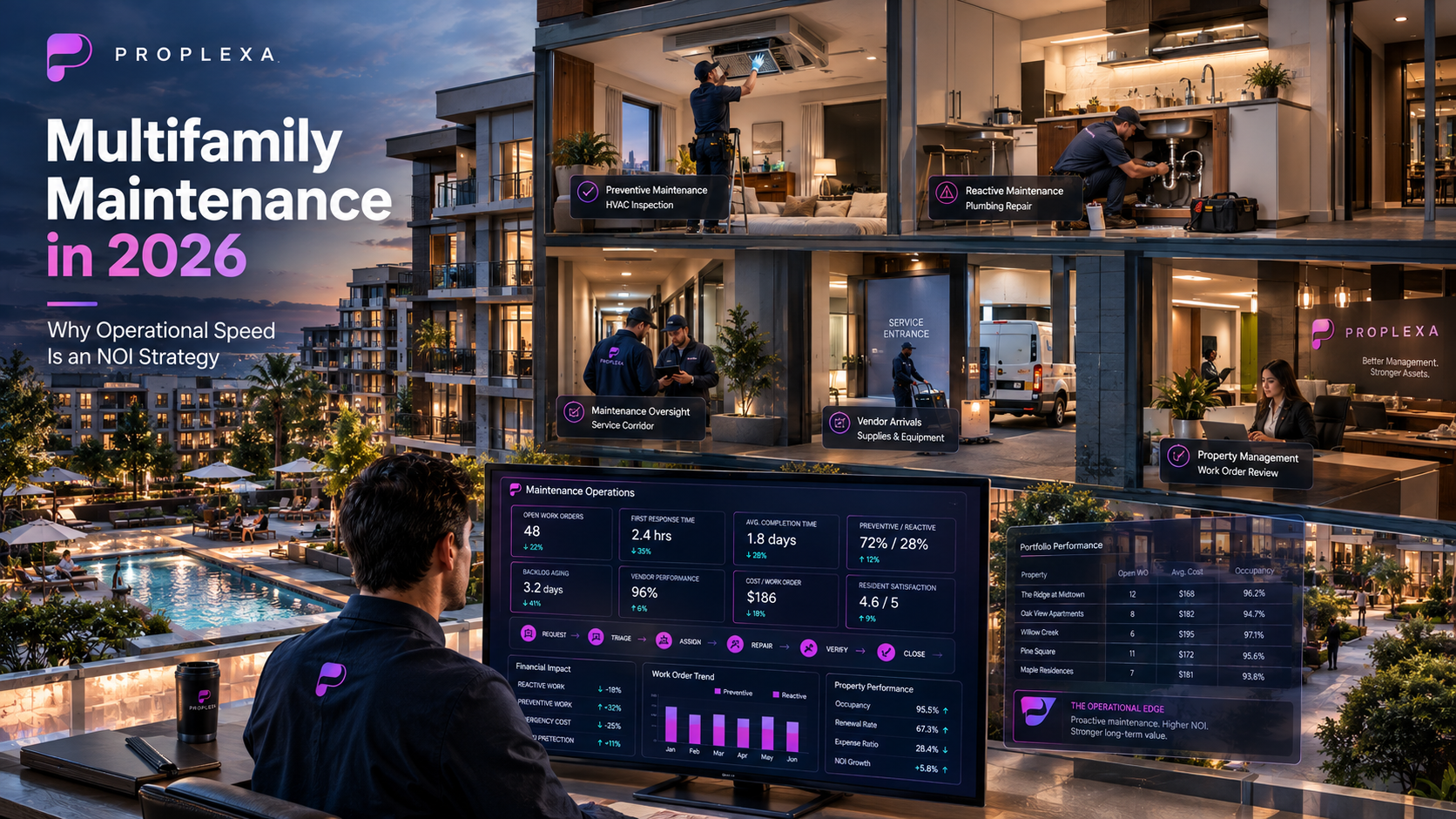
Maintenance is usually categorized as an expense.
That is technically correct—but strategically incomplete.
For multifamily investors, maintenance is also a performance system that affects operating expenses, resident satisfaction, staff productivity, emergency repairs, vacancy exposure and the long-term condition of the asset.
In 2026, the difference between a reactive maintenance operation and a preventive one is becoming increasingly important.
The Reactive Maintenance Problem
The National Apartment Association's 2026 research found that rental housing professionals spend an average of 26% of their work time on reactive, issue-driven activities. Maintenance professionals are even more exposed: nearly 40% of their time is spent responding to issues, the highest share among the roles studied.
That creates an operational problem.
Every recurring emergency consumes:
- Technician hours
- Vendor capacity
- Manager attention
- Resident communication
- Administrative time
- Potential overtime
- Potential unit downtime
Reactive maintenance is therefore not simply a repair philosophy.
It is a resource-allocation model.
Preventive Maintenance Changes the Economics
Preventive maintenance attempts to move work from an emergency state into a planned operating process.
Examples include:
- HVAC inspections
- Filter replacement
- Plumbing inspections
- Roof inspections
- Appliance checks
- Preventive pest control
- Water-heater inspections
- Electrical inspections
- Common-area equipment checks
The objective is not to eliminate repairs.
It is to identify problems while they are still relatively predictable, schedulable and controllable.
IREM's 2026 guidance similarly connects preventive maintenance with energy efficiency, reduced failure risk, lower disruption and longer asset life.
Maintenance Is Also a Resident-Experience Metric
Maintenance has another financial dimension: residents experience it directly.
Buildium's 2026 renter research found that 24% of renters identify maintenance as the most stressful part of the rental experience, while 84% expect a response from their property manager within 24 hours.
AppFolio's 2026 renter research also found a significant relationship between maintenance satisfaction and resident behavior: 56% of residents satisfied with maintenance reported planning to renew, compared with 31% among residents dissatisfied with maintenance.
These figures should not be interpreted as proof that maintenance alone determines renewal decisions. But they demonstrate why maintenance performance belongs in the broader resident-retention and asset-performance conversation.
Owners Are Hiring Property Managers for Maintenance Expertise
Maintenance is also central to the owner–property-manager relationship.
According to Buildium's 2026 Property Management Industry Report, 56% of rental owners who work with a property manager say maintenance support is the main reason they hired one.
Its 2026 owner research found that 59% of owners consider maintenance and repairs the most valuable service their property manager provides.
That creates a clear business implication for PMCs:
Maintenance is not merely something you perform. It is something you should be able to demonstrate.
The Metrics Owners Should Actually Track
A monthly maintenance report should go considerably further than:
“We completed 143 work orders.”
Owners should examine the operational mechanics behind those orders.
1. First Response Time
How long does it take for the resident or owner to receive the initial response?
2. Time to Completion
How long does the average work order remain open?
3. Emergency Percentage
What percentage of maintenance activity is classified as emergency work?
4. Repeat Work Orders
How frequently does the same unit or asset require another repair for the same problem?
5. Preventive vs. Reactive Work
What percentage of maintenance activity is planned rather than triggered by failure?
6. Vendor Performance
Which vendors consistently meet cost, quality and completion-time expectations?
7. Cost per Work Order
What is the average total cost, including labor and materials?
8. Resident Satisfaction
How do residents evaluate completed maintenance requests?
The objective is not to maximize every metric independently.
It is to understand whether the maintenance operation is becoming more predictable, efficient and proactive.
The Hidden KPI: Maintenance Backlog
One of the most useful metrics for owners is the open-work-order backlog.
Consider two properties:
Property A
- 40 open work orders
- Average age: 2 days
- 85% completed within target
Property B
- 20 open work orders
- Average age: 14 days
- 45% completed within target
Property B has fewer open tickets.
But its operational risk may be substantially greater.
That is why owners should monitor both volume and aging.
A maintenance dashboard should show:
Open Orders → Aging → Priority → Assigned Vendor/Technician → Estimated Completion → Actual Completion
This turns maintenance from a list of repairs into an operational performance system.
Staffing Is Part of the Equation
Maintenance performance also depends on labor availability.
NAA's Q2 2026 Apartment Labor Market Dynamics Report found that advertised salaries for maintenance technicians increased 3.8% year over year nationally, while property/community manager salaries increased 3.5%.
For property managers, this means that maintenance staffing is not simply a headcount decision.
It becomes a question of:
How much productive maintenance capacity does each dollar of labor create?
A property manager who reduces reactive work can potentially free technicians for inspections, preventive work and higher-value assignments without simply adding headcount.
How Owners Should Evaluate a Property Manager
Instead of asking:
“Do you handle maintenance?”
Owners should ask:
- What is your average first-response time?
- What percentage of work orders are completed within SLA?
- What is the average work-order age?
- How large is the current backlog?
- What percentage of work is preventive?
- How do you evaluate vendors?
- How do you detect repeat failures?
- How are emergency calls escalated?
- How are maintenance costs benchmarked?
- How do owners receive maintenance reporting?
- How do you document completed work?
- What happens when a property consistently misses maintenance targets?
These questions reveal considerably more about operational capability than a simple description of services.
Maintenance Can Protect NOI Without Cutting Service
There is an important distinction between cost reduction and operational efficiency.
Cutting maintenance spending indiscriminately may reduce expenses in the short term while increasing emergency repairs, resident dissatisfaction and deferred capital needs.
A better objective is:
Lower the cost of failure.
That can come from:
- Preventive inspections
- Better vendor procurement
- Faster diagnosis
- Standardized workflows
- Better inventory management
- Automated resident communication
- Repeat-failure analysis
- More accurate work-order categorization
- Centralized operational reporting
The goal is not “spend less on maintenance.”
The goal is:
Generate better asset performance per maintenance dollar.
Where Proplexa Fits
For property owners, the challenge is often not finding a company that offers maintenance.
Almost every professional property management company does.
The harder question is determining how that company actually operates maintenance at scale.
A Proplexa RFP can help owners compare management companies across operational dimensions such as:
- Preventive maintenance strategy
- Work-order processes
- Vendor management
- Response-time standards
- Reporting
- Technology
- Staffing
- Financial controls
- Resident communication
That makes the management selection process less dependent on a management fee or a polished sales presentation.
The objective is to compare the operating model behind the contract.
The Bottom Line
Maintenance is often treated as a necessary cost of owning apartments.
A more sophisticated approach treats it as an operational lever.
In 2026, when maintenance teams spend a substantial portion of their time responding to issues and owners increasingly expect property managers to demonstrate operational value, the distinction between reactive and preventive maintenance matters.
The best maintenance question is therefore not:
“How much did we spend?”
It is:
“What performance did we get from the maintenance operation?”
That is the question that connects work orders to operations—and operations to NOI.