
Hiring a property management company isn't simply an operational decision.
It's an investment decision.
The company you choose will influence occupancy, resident retention, operating expenses, Net Operating Income (NOI), property reputation, and ultimately the value of your asset.
Yet many owners still hire managers based primarily on referrals or management fees.
Institutional investors approach the decision differently.
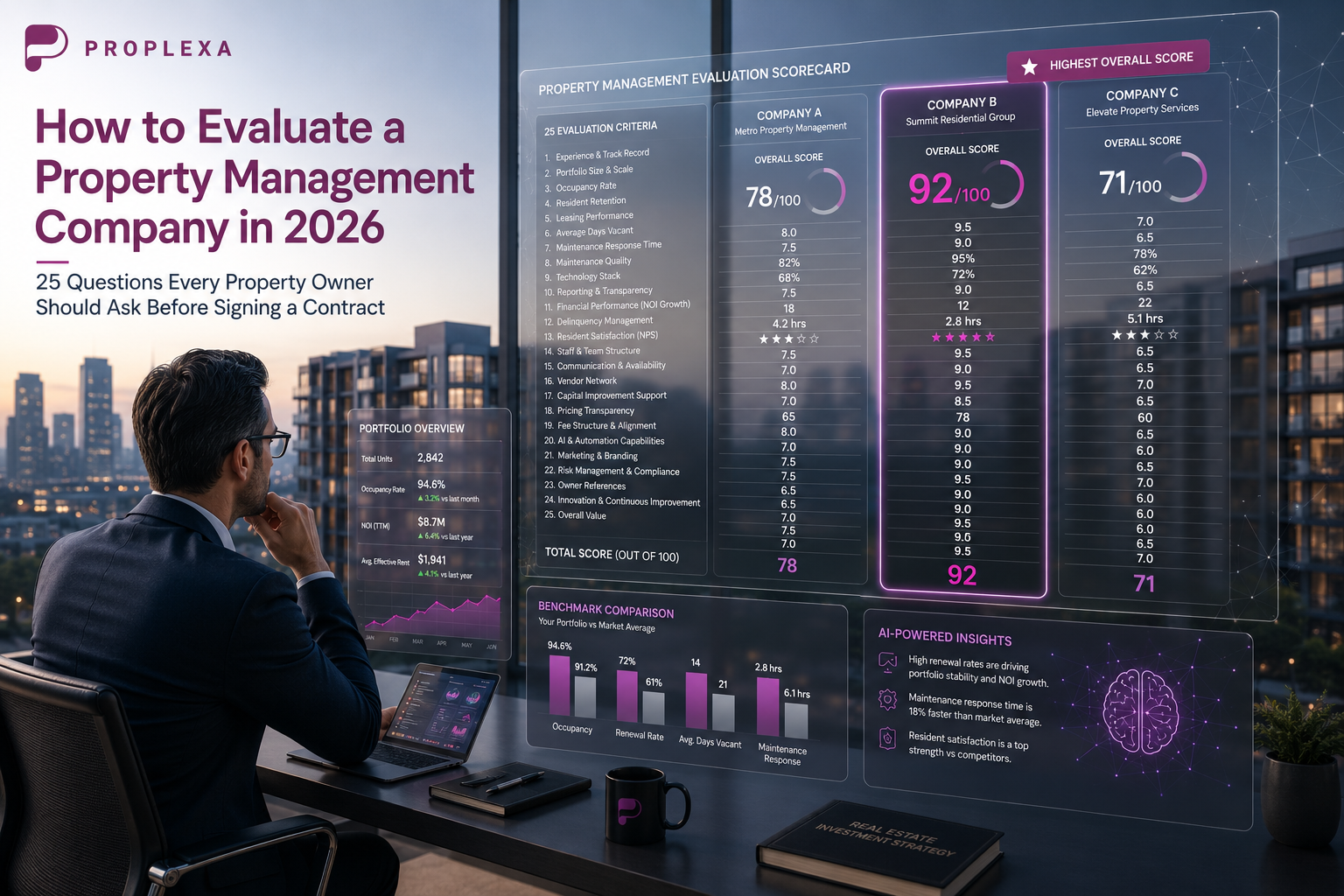
They use structured evaluation criteria, compare multiple operators, analyze performance metrics, and treat property management as a measurable business function.
If you're evaluating a new management partner in 2026, these are the questions that matter most.
1. How Much Experience Do You Have Managing My Property Type?
Managing:
• Multifamily
• Single-family rentals
• Student housing
• Build-to-rent communities
• Mixed-use developments
requires different operational expertise.
Experience within your asset class matters far more than total years in business.
2. What Is Your Current Portfolio Size?
Ask:
• Units under management
• Number of communities
• Geographic markets
• Average portfolio size
Large enough to have systems.
Small enough to remain responsive.
3. What Is Your Average Occupancy Rate?
Top operators should easily provide this.
Compare:
Physical Occupancy
Economic Occupancy
Average Vacancy Days
These numbers reveal operational effectiveness.
4. What Are Your Resident Renewal Rates?
Renewals directly impact NOI.
Ask:
Average renewal %
12-month trend
Resident retention initiatives
Benchmark against market averages whenever possible.
5. What Is Your Average Leasing Conversion Rate?
Important metrics include:
Lead-to-tour conversion
Tour-to-lease conversion
Average leasing cycle
Average days vacant
These KPIs measure leasing efficiency.
6. How Quickly Do You Respond to Maintenance Requests?
Request data on:
Average response time
Emergency response
Work order completion
Resident satisfaction
Maintenance is one of the strongest drivers of online reviews and lease renewals.
7. What Technology Stack Do You Use?
Leading firms increasingly rely on platforms such as AppFolio, Buildium, Yardi, Entrata, RealPage, AI leasing assistants, resident portals, electronic payments, maintenance automation, CRM systems, and business intelligence dashboards.
Technology is now a competitive advantage—not just an operational convenience.
8. What Reports Will I Receive?
Owners should expect recurring reports that include:
• NOI
• Delinquency
• Occupancy
• Leasing velocity
• Budget vs. actual
• Maintenance performance
• CapEx tracking
Transparency matters.
9. How Do You Handle Delinquencies?
Ask about:
Collection procedures
Payment plans
Eviction coordination
Legal compliance
Average delinquency rates
10. How Do You Screen Residents?
Professional operators typically verify:
Income
Employment
Rental history
Credit
Criminal background (where legally permissible)
Identity
A strong screening process helps reduce future operational risk.
11. What Is Your Average Resident Satisfaction Score?
Increasingly measured through:
NPS (Net Promoter Score)
Resident surveys
Online reviews
Google ratings
Review response rates
12. What Is Your Staff-to-Unit Ratio?
Operational capacity matters.
Ask how many:
Community managers
Maintenance technicians
Leasing professionals
Regional managers
support each portfolio.
13. How Do You Reduce Turnover?
The best operators have documented retention strategies—not just renewal reminders.
14. What Is Your Vendor Network?
Vendor quality directly affects:
Repair costs
Completion times
Resident experience
Emergency response
15. How Do You Handle Capital Improvements?
Ask whether they assist with:
Bid management
Vendor coordination
Project oversight
Capital planning
16. What Is Included in Your Management Fee?
Don't compare percentages.
Compare services.
Understand:
Included services
Additional charges
Leasing fees
Renewal fees
Inspection fees
Project management fees
Technology fees
17. How Often Will We Meet?
Communication cadence should be defined before signing.
18. Can You Provide Benchmark Data?
Sophisticated firms benchmark clients against comparable portfolios.
19. What Is Your Average Owner Retention Rate?
Companies with long-term clients often deliver more consistent performance.
20. How Do You Use Artificial Intelligence?
In 2026, AI is increasingly used for:
Leasing inquiries
Resident communication
Maintenance triage
Portfolio analytics
Predictive reporting
Operational forecasting
21. What Is Your Disaster Recovery Plan?
Owners should understand procedures for:
Natural disasters
Cybersecurity incidents
Power outages
Emergency communications
Insurance coordination
22. Can I Speak With Existing Clients?
References remain invaluable.
23. How Do You Measure Success?
The answer should extend beyond occupancy.
Look for:
NOI
Renewals
Resident satisfaction
Expense control
Leasing speed
Owner satisfaction
24. How Will You Help Increase My Asset's Value?
Strong operators discuss:
Revenue growth
Expense optimization
Capital planning
Resident retention
Technology
Operational efficiencies
25. Why Should I Choose You Over Other Management Companies?
This final question often reveals more than the previous twenty-four combined.
Listen carefully.
The best companies discuss measurable outcomes—not generic promises.
Why Comparing Multiple Management Companies Is No Longer Optional
Imagine buying an apartment building after reviewing only one financing proposal.
Or hiring a contractor after requesting only one quote.
Few sophisticated investors would.
Yet many property owners still hire the first management company they meet.
That approach limits transparency, weakens negotiating leverage, and makes it difficult to evaluate whether a proposal truly represents the best long-term value.
Competitive comparisons provide context.
They reveal differences in pricing, technology, service levels, experience, reporting capabilities, and operational performance—helping owners make decisions based on evidence rather than assumptions.
How Proplexa Makes This Process Simpler
Proplexa was built around one simple idea:
Property owners deserve the same transparency when selecting a property management company that they expect in every other major business decision.
Instead of relying on referrals or a single proposal, owners can publish an RFP, receive proposals from multiple vetted property management companies, and compare them side by side using standardized operational metrics.
That means comparing far more than just management fees.
It means evaluating the factors that actually influence portfolio performance.
Final Thoughts
Choosing the right property management company isn't about finding the cheapest provider.
It's about finding the partner most capable of increasing occupancy, retaining residents, improving operations, and maximizing long-term asset value.
In 2026, the most successful real estate investors aren't making this decision based on intuition.
They're making it based on data.