
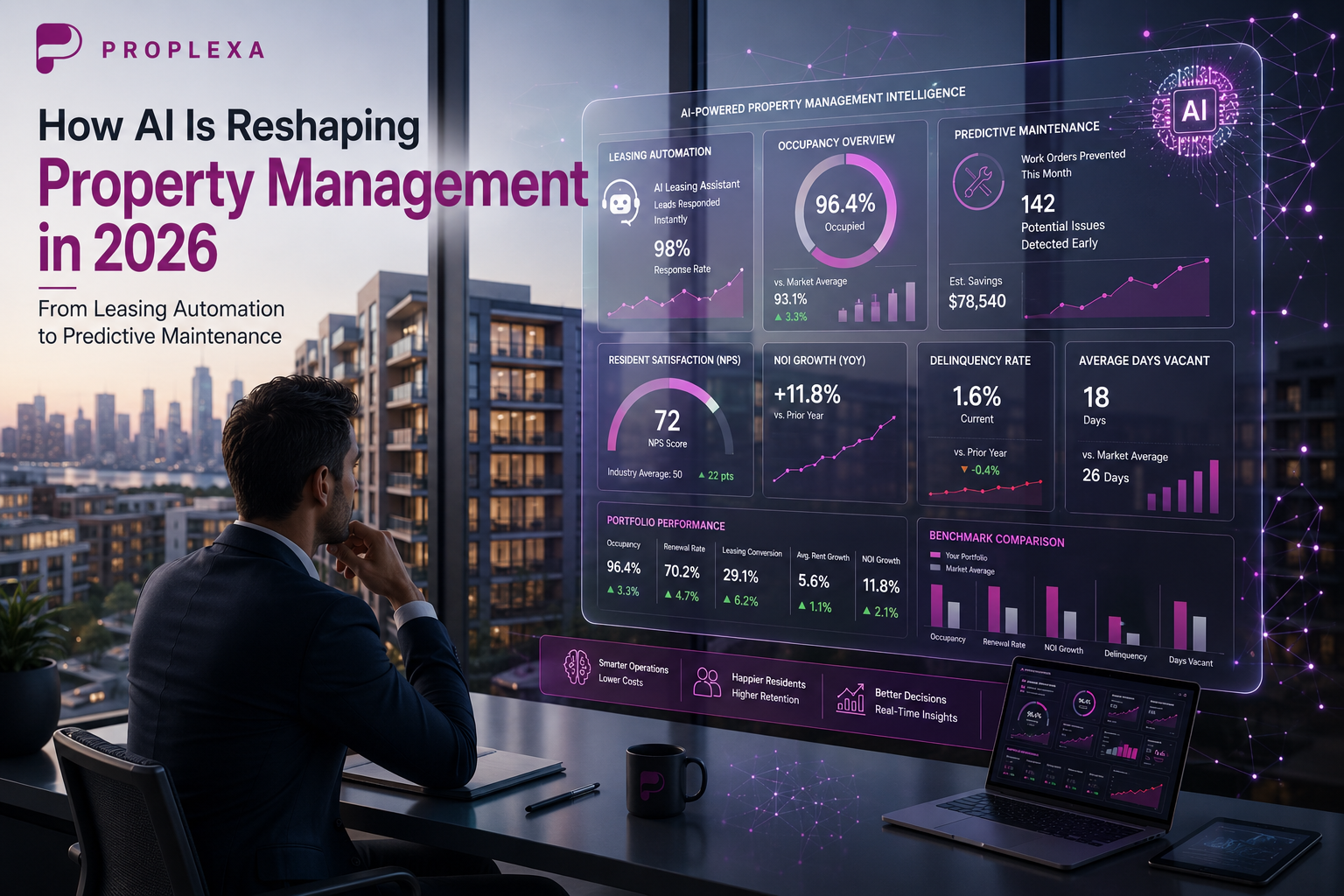
Artificial Intelligence is no longer an emerging technology in real estate.
It is becoming an operational advantage.
Over the past two years, property management companies have accelerated investments in automation, data analytics, and AI-powered workflows.
The goal is simple:
Operate portfolios more efficiently.
Reduce costs.
Improve resident experiences.
Increase owner transparency.
And ultimately, drive stronger financial performance.
For owners and operators alike, 2026 may represent the beginning of a structural transformation in how rental housing is managed.
Why AI Adoption Is Accelerating
Property managers face increasing pressure.
Residents expect:
• Faster responses
• Digital-first experiences
• 24/7 availability
Owners expect:
• Better reporting
• Greater transparency
• Improved NOI
Meanwhile, labor costs remain elevated.
Maintenance teams remain difficult to hire.
Leasing competition continues to intensify.
AI addresses many of these challenges simultaneously.
1. AI Leasing Assistants
One of the fastest growing applications.
AI systems can:
Answer inquiries instantly
Schedule showings
Follow up automatically
Qualify prospects
Handle repetitive questions
Benefits include:
Higher lead conversion
Reduced leasing costs
Shorter vacancy periods
Some operators report response times improving from several hours to less than one minute.
2. Predictive Maintenance
Traditional maintenance is reactive.
Something breaks.
Residents complain.
Repairs happen.
AI changes this.
By analyzing:
HVAC history
Sensor information
Repair patterns
Equipment age
Systems can estimate:
Failure probability
Replacement timing
Maintenance budgets
Benefits:
Fewer emergencies
Lower repair costs
Improved resident satisfaction
3. Portfolio Intelligence
Owners increasingly expect dashboards.
AI platforms can now analyze:
Occupancy trends
Rent growth
Turnover patterns
Delinquencies
Maintenance spending
Renewal behavior
Instead of reading reports.
Owners receive insights.
Examples:
Portfolio A is underperforming peers.
Property B shows unusual vacancy patterns.
Property C may benefit from lease restructuring.
4. Resident Communication
Communication remains one of the industry's largest pain points.
AI assistants now support:
Multilingual communication
Resident FAQs
Maintenance updates
Move-in instructions
Renewal reminders
This provides:
Consistency
Availability
Reduced workload
And residents increasingly expect this level of service.
5. AI-Powered Benchmarking
Perhaps the most important shift.
AI doesn't simply automate.
It compares.
It learns.
It identifies patterns.
Questions owners may soon ask:
How does my occupancy compare to similar assets?
Which managers retain residents best?
Who delivers the fastest maintenance response?
What operational decisions maximize NOI?
This level of benchmarking is likely to become standard over the next decade.
Challenges Remain
AI is not replacing property managers.
It is augmenting them.
Human expertise remains essential.
For:
Owner relationships
Complex negotiations
Capital planning
Legal compliance
Crisis situations
The most successful firms will probably combine:
Technology
Processes
Human expertise
Rather than relying exclusively on any one component.
What This Means for Investors
The implications are significant.
Property owners selecting management companies should increasingly evaluate:
Technology stack
Reporting capabilities
Automation tools
AI adoption strategy
Communication systems
Benchmarking capabilities
Management firms unable to modernize may find themselves at a competitive disadvantage.
Why This Matters for Proplexa
At Proplexa, we believe the future of property management selection will become increasingly transparent, measurable, and technology-driven.
Property owners should not simply compare fees.
They should compare capabilities.
Response times.
Technology.
Operational sophistication.
Performance.
Because the firms embracing innovation today may be the firms delivering stronger portfolio outcomes tomorrow.
Final Thoughts
Artificial Intelligence is unlikely to replace property managers.
But property managers using AI may increasingly outperform those who do not.
In an industry where occupancy, retention, and NOI can dramatically influence asset values, operational advantages matter.
And in 2026, AI is rapidly becoming one of the most important operational advantages