
For years, multifamily investors have benefited from a powerful combination:
NOI growth + rent growth + cap rate compression + leverage.
When those forces move in the same direction, asset values can rise rapidly.
But the 2026 market requires a different mindset.
Cap rate compression can no longer be treated as a reliable source of appreciation.
Interest rates remain influential.
New supply continues to affect certain markets.
Operating costs remain important.
And investors are placing greater emphasis on actual property income.
The result is a simple but important shift:
In 2026, operational NOI growth may matter more than financial engineering.
For multifamily investors, understanding this relationship is critical.
The Basic Formula Behind Multifamily Valuation
At its most fundamental level, income-producing real estate can be valued using:
Property Value = NOI ÷ Capitalization Rate
That equation is simple.
The implications are not.
Consider a property producing:
$1,000,000 NOI
At a:
5.0% cap rate
Its implied value is:
$20 million
Now imagine the same property at a 6.0% cap rate.
The implied value becomes:
$16.67 million
Nothing about the physical building necessarily changed.
The income didn't change.
The valuation changed because the market's required yield changed.
This is why cap rates are one of the most important concepts in commercial real estate.
What Is a Cap Rate?
A capitalization rate is essentially the relationship between a property's NOI and its value.
The simplified formula is:
Cap Rate = NOI ÷ Property Value
Rearranged:
Property Value = NOI ÷ Cap Rate
Cap rates allow investors to compare the income characteristics of different properties and markets.
But a cap rate is not an interest rate.
It is not a mortgage rate.
And it is not a guaranteed return.
It is a market-based valuation metric influenced by factors including:
- Interest rates
- Risk
- Property quality
- Location
- Growth expectations
- Tenant profile
- Supply and demand
- Financing conditions
- Investor sentiment
- Expected future cash flows
Where Are Multifamily Cap Rates in 2026?
The 2026 market demonstrates why investors need to think carefully about valuation.
Fannie Mae reported that multifamily capitalization rates were estimated at 5.8% in Q1 2026, compared with 5.6% in Q4 2025 and an average of 5.6% for 2025. Fannie Mae also noted that multifamily property valuations remained flat year over year during Q1.
CBRE's H1 2026 Cap Rate Survey provides an even broader market perspective, incorporating 3,600 cap-rate estimates across more than 50 U.S. markets based on input from more than 200 CBRE professionals.
CBRE's midyear 2026 outlook also says cap rates are expected to remain largely stable during 2026, with incremental compression expected in 2027. The implication is important:
Investors should not build their 2026 business plan around aggressive cap rate compression.
The Old Value-Creation Model
Historically, an investor could potentially generate significant appreciation through several simultaneous mechanisms.
For example:
Year 1
Purchase property:
$20 million
NOI:
$1 million
Cap rate:
5.0%
Year 3
NOI grows to:
$1.1 million
Market cap rate compresses to:
4.5%
Value:
$24.44 million
The investor benefited from two sources of value creation:
NOI growth
and
cap rate compression.
That combination can be extremely powerful.
But it can also create dangerous assumptions.
The Problem With Assuming Cap Rate Compression
Suppose the same investor assumes:
- NOI growth
- Continued rent growth
- Falling cap rates
- Lower interest rates
- Strong transaction liquidity
What happens if the cap rate doesn't compress?
The investment must rely much more heavily on actual income growth.
That's exactly the environment investors are facing in 2026.
CBRE's current outlook calls for relatively stable cap rates in 2026 rather than the broad compression previously anticipated.
This makes operating performance more important.
NOI Becomes the Primary Value-Creation Lever
Consider a multifamily property with:
$2,000,000 NOI
At a:
5.5% cap rate
Value:
$36.36 million
Now suppose an operator improves annual NOI by 10%.
New NOI:
$2.2 million
At the same 5.5% cap rate:
$40 million
The property has created approximately:
$3.64 million in additional implied value.
No cap rate compression was required.
No market multiple expansion was required.
The value was created through income.
This Is the Part Investors Often Miss
When investors evaluate a property manager, they frequently ask:
"What is your management fee?"
That's understandable.
But the more important question may be:
"What can your operating platform do to improve sustainable NOI?"
Because a management fee is an expense.
NOI is an economic output.
The two should not be evaluated in isolation.
A Higher Management Fee Can Sometimes Produce a Higher Return
Consider two management companies.
Company A
Management fee:
4%
Projected NOI:
$1,000,000
Company B
Management fee:
6%
Projected NOI:
$1,100,000
Company B costs more.
But if its operating platform produces materially stronger revenue performance, retention, collections and expense management, the additional fee could be economically rational.
The investor should compare:
Total economic value created
—not simply—
Management fee percentage.
This is one of the fundamental principles behind Proplexa.
The Mathematics of NOI Growth
Let's take a $30 million multifamily asset.
Current NOI:
$1.8 million
Cap rate:
6.0%
Implied value:
$30 million
Now assume an operator increases NOI by:
3%
NOI:
$1.854M
Value at 6%:
$30.9M
5%
NOI:
$1.89M
Value:
$31.5M
10%
NOI:
$1.98M
Value:
$33M
The cap rate didn't move.
The market didn't save the investor.
Operational performance created the value.
Why 2026 Makes This More Important
CBRE's Q2 2026 multifamily data shows that the market continues to absorb substantial supply.
In Q2:
- Net absorption reached 167,000 units
- 77,700 units were completed
- Multifamily vacancy was 4.3%
- Average monthly rent reached $2,257
- Multifamily investment volume was $34.9 billion
But market-level averages hide significant differences between individual properties and markets.
A property competing against a large amount of new supply cannot assume that rent growth alone will solve its problems.
Execution matters.
Occupancy Is Not the Same as Economic Performance
One of the biggest mistakes in multifamily analysis is looking at physical occupancy without examining the quality of revenue.
Consider two properties.
Property A
Physical occupancy:
95%
But:
- High concessions
- High delinquency
- Significant bad debt
- Low renewal rate
Property B
Physical occupancy:
94%
But:
- Strong collections
- High renewal rate
- Low concessions
- Low bad debt
Property B could potentially generate stronger effective revenue despite having slightly lower physical occupancy.
This is why sophisticated investors examine:
Economic occupancy
rather than relying exclusively on physical occupancy.
Revenue Growth Is Only Half the Equation
NOI does not depend solely on revenue.
The other side is:
Operating expenses.
An operator can improve NOI through:
Revenue optimization
- Rent optimization
- Lease-up velocity
- Renewal management
- Concession control
- Collection performance
Expense optimization
- Preventive maintenance
- Vendor management
- Utility management
- Labor efficiency
- Insurance management
- Procurement
This is why NOI growth should be analyzed as a combination of:
Revenue growth − expense growth
rather than simply rent growth.
Expense Growth Can Destroy Valuation
Imagine:
Revenue increases:
5%
But operating expenses increase:
8%
The investor may experience disappointing NOI growth despite apparently strong revenue performance.
This is particularly relevant in an environment where operating costs remain an important consideration for multifamily owners.
A strong property manager therefore needs to manage both sides of the income statement.
Same Property. Different Operator. Different Value.
Consider two identical 250-unit communities.
Both have:
$2.5M NOI
$40M value
6.25% cap rate
Now Operator A produces 2% annual NOI growth.
Operator B produces 5%.
After five years, ignoring cap-rate changes:
Operator A
NOI:
Approximately $2.76M
Operator B
NOI:
Approximately $3.19M
At the same 6.25% cap rate:
Operator A Value
Approximately:
$44.2M
Operator B Value
Approximately:
$51.0M
That's a difference of roughly:
$6.8 million
from the same starting asset.
The example is hypothetical, but the underlying valuation mechanics are real.
Cap Rate Expansion Is the Risk Investors Need to Model
Investors should also run the opposite scenario.
Suppose:
NOI:
$2 million
Current cap rate:
5.5%
Value:
$36.36M
Now the market reprices the asset to:
6.0%
Value:
$33.33M
The value decline is approximately:
$3.03 million
even though NOI did not change.
This is known as cap rate expansion.
It is one of the most important downside risks in commercial real estate.
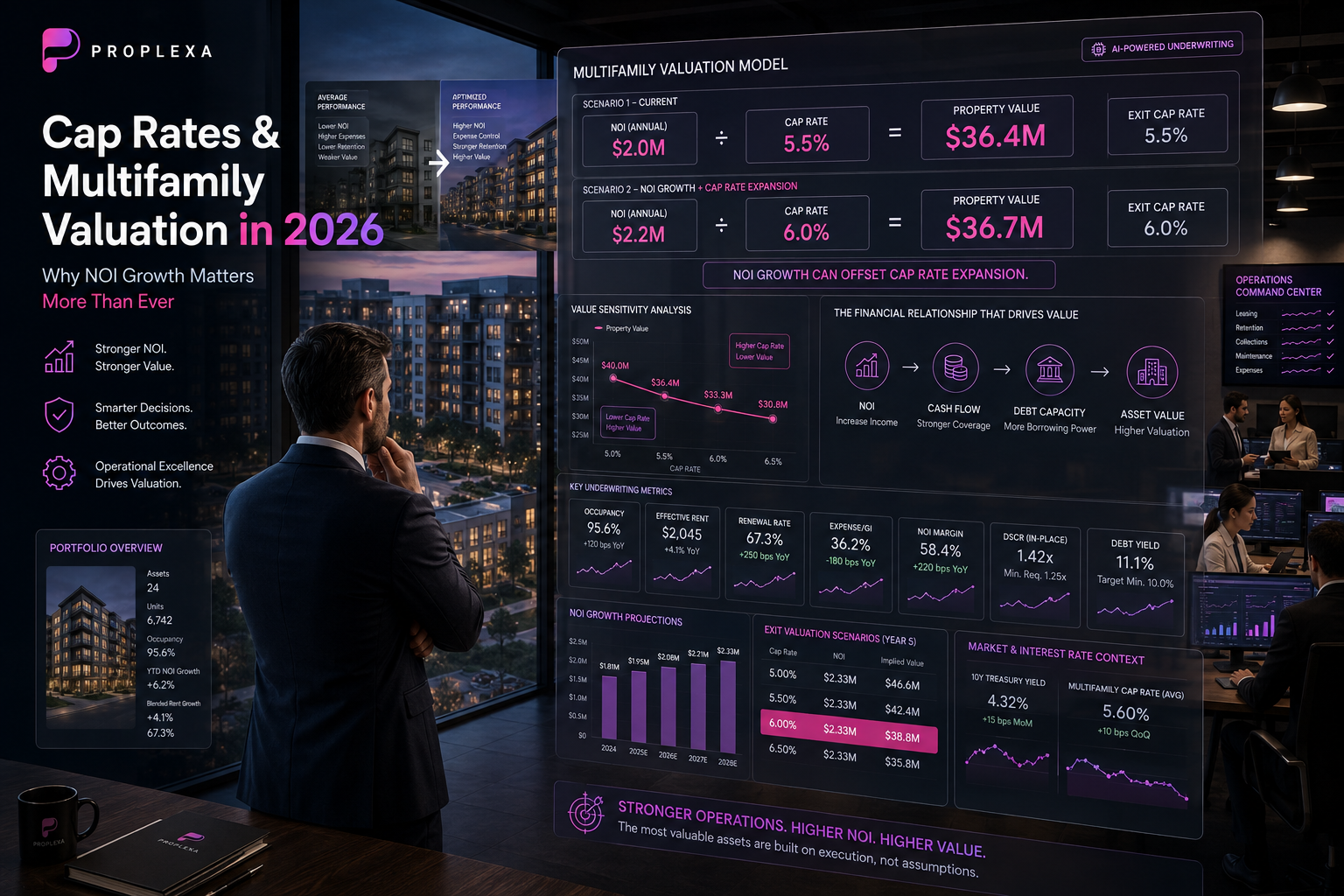
NOI Growth Can Offset Some Cap Rate Expansion
Now consider that the investor grows NOI from:
$2M
to:
$2.2M
while the cap rate expands from:
5.5% → 6.0%
New value:
$2.2M ÷ 6% = $36.67M
Despite cap rate expansion, the property maintains approximately its original value.
This is the strategic importance of NOI growth.
It creates a buffer against multiple compression.
The "Exit Cap Rate" Problem
This becomes even more important when investors underwrite acquisitions.
Suppose an investor assumes:
Entry cap rate:
5.5%
Exit cap rate:
5.0%
That assumption creates valuation expansion.
But what if the actual exit cap rate is:
6.0%?
The exit valuation can be dramatically lower.
Sophisticated underwriting should therefore stress-test:
- Base exit cap
- +25 bps
- +50 bps
- +75 bps
- +100 bps
The purpose isn't to predict the future.
It is to understand the investment's sensitivity to changing market conditions.
Cap Rate Spread Matters Too
Cap rates don't exist in isolation.
Investors also consider the relationship between property yields and broader capital markets.
Fannie Mae noted in its Q1 2026 filing that the spread between multifamily capitalization rates and the 10-year Treasury remained significantly narrower than the spread observed before 2022.
That matters because investors compare real estate yields with alternative investments and financing costs.
If risk-free yields remain elevated, investors may demand greater returns from real estate.
That can put upward pressure on cap rates.
The New 2026 Investor Mindset
The market increasingly rewards investors who can answer three questions:
1. What is the property worth today?
2. What can the property realistically earn?
3. How resilient is that income under stress?
Those questions are more important than simply asking:
"What cap rate can I buy at?"
A Better Multifamily Underwriting Framework
Instead of focusing on a single projected IRR, investors should evaluate:
Current NOI
What does the property actually generate?
NOI Growth
What realistic operational improvements are available?
Cap Rate
What is the market requiring today?
Exit Cap Rate
What happens if valuation multiples change?
Revenue Growth
How much growth comes from rent versus occupancy and retention?
Expense Growth
Are expenses growing faster than revenue?
Debt Service
Can the property support the financing under downside scenarios?
Exit Value
What happens under different cap-rate assumptions?
This creates a much more resilient investment model.
What Property Managers Have to Do With Cap Rates
At first glance, cap rates may appear to be an investment-banking topic.
They aren't.
Property management influences the NOI numerator in the valuation equation.
That means management performance can influence asset value.
For example:
Better leasing
→ Higher occupancy
→ Higher effective revenue
→ Higher NOI
→ Higher property value
Or:
Better maintenance
→ Lower unexpected expenses
→ Better resident experience
→ Higher retention
→ Lower turnover
→ Higher NOI
→ Higher value
The connection is operational—but the outcome is financial.
Why Owners Should Benchmark Operators
If two property management companies claim they can improve performance, investors should ask:
By how much?
And:
Based on what evidence?
Owners should compare:
- Historical occupancy
- Renewal rates
- Leasing velocity
- Collection rates
- Expense ratios
- Maintenance performance
- NOI growth
- Reporting quality
- Technology capabilities
- Portfolio benchmarks
The goal isn't to find the cheapest manager.
It is to find the operator capable of producing the strongest risk-adjusted economic outcome.
How Proplexa Fits Into the Valuation Equation
This is where Proplexa's marketplace becomes particularly relevant.
Property owners can use Proplexa to receive and compare property management proposals rather than evaluating a single operator in isolation.
That creates a more competitive decision process.
Instead of asking:
"Which company charges the lowest fee?"
Owners can ask:
"Which operator offers the strongest combination of cost, capabilities, execution and expected asset performance?"
That is a fundamentally better investment question.
The Bottom Line
The 2026 multifamily market is teaching investors an important lesson.
You cannot control the cap rate.
You cannot control Treasury yields.
You cannot control macroeconomic conditions.
You cannot control how much competing supply enters the market.
But you can influence how efficiently your property operates.
You can improve:
- Leasing
- Retention
- Collections
- Maintenance
- Revenue management
- Expense controls
- Resident experience
- Reporting
And those operational decisions can influence NOI.
The valuation equation is unforgiving:
Higher NOI = Higher value, assuming the cap rate remains constant.
And when cap rates expand?
Strong NOI growth can provide an important buffer.
That's why the most sophisticated multifamily investors in 2026 should think about property management differently.
It isn't simply an operating function.
It is a value-creation function.